
Semana Santa in Oaxaca: A Cultural Guide to Tradition and Ritual
Easter is familiar in many places.
A single day.
A defined celebration.
Something marked, then passed.
In Oaxaca, it doesn’t feel like that.
Semana Santa unfolds slowly. Over days, not hours. Through processions, not events. Through repetition, not spectacle.
You don’t arrive at a single moment.
You step into something already in motion.
The Rhythm of the Week
Semana Santa — Holy Week — is not one event.
It is a sequence that moves through the days leading up to Easter Sunday.
Beginning with Palm Sunday (Domingo de Ramos), the week progresses through Holy Thursday and Good Friday, before reaching Easter itself. Each day carries its own meaning, but in Oaxaca, the emphasis is less on isolated moments and more on the continuity between them.
There is a rhythm to the week.
Not rushed.
Not condensed.
But extended, deliberate, and repeated.
Time feels structured differently. The city follows a pattern that has been observed for generations, where each day builds quietly on the one before it.

Processions Through the Streets
One of the most visible expressions of Semana Santa in Oaxaca is the procession.
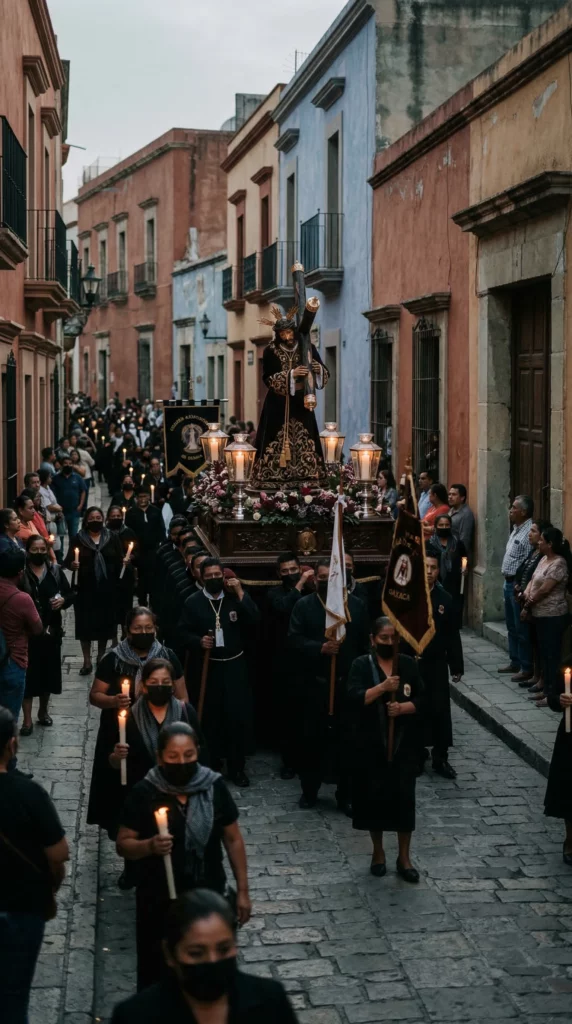
These are not performances. They move slowly, often in near silence, through the narrow streets of the historic centre. Religious statues are carried carefully through the city, accompanied by candlelight and small groups of participants walking alongside.
There is no sense of urgency.
The pace is measured. The movement intentional.
As the processions pass through plazas and along stone streets, the city itself becomes part of the experience. Sound is muted. The usual rhythm of daily life adjusts around what is taking place.
It is not something that demands attention.
It holds it.

Faith in Public Space
In Oaxaca, faith does not remain inside churches.
It moves outward.
During Semana Santa, religious expression becomes visible in public space — in streets, plazas, and neighbourhood routes that form the path of the processions. Churches still anchor the events, but the experience is not confined to them.
It unfolds across the city.
This shift changes the way the week is experienced. Religion is not something observed at a distance or at a specific time. It becomes part of the environment, present as people move through the same spaces for entirely different reasons.
The sacred and the everyday sit side by side.
Tradition and Continuity
What stands out most is not the scale, but the consistency.
Semana Santa in Oaxaca is not something newly created or adapted for visitors. It follows patterns that have been maintained over time, passed between generations and repeated with care.
Preparation happens quietly in the background.
Families, communities, and local groups take part in ways that are not always visible at first glance. The processions, the timing, the structure of the week — all of it reflects continuity rather than reinvention.
It is not designed to feel new.
It is designed to continue.

The Visual Language of Semana Santa
There is a visual consistency to Semana Santa that reveals itself gradually.
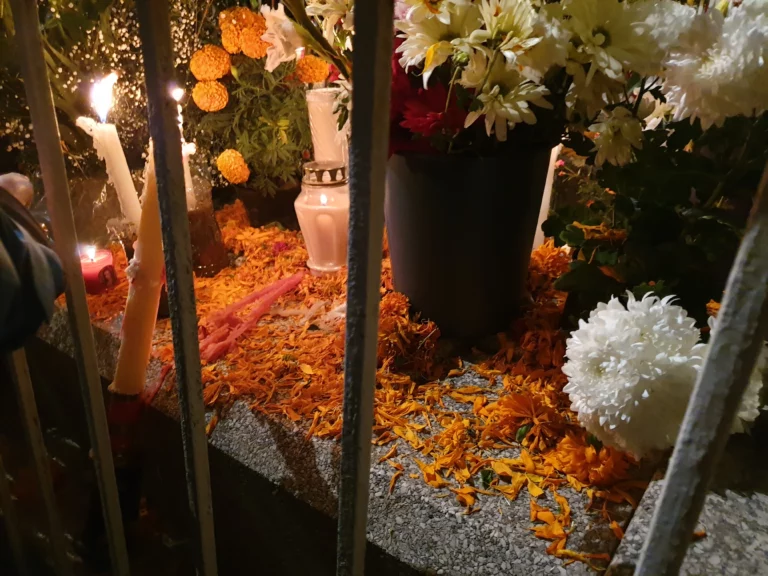
Candles carried through dimly lit streets.
Flowers placed with intention.
Religious imagery repeated across different processions.
Unlike other celebrations in Mexico, the atmosphere here is more restrained.
Colour is present, but not overwhelming. Movement is steady rather than energetic. The tone leans toward reflection rather than celebration.
The details are simple, but deliberate.
And it is through these details that the meaning becomes clearer.
Oaxaca as a Setting for Ritual
Oaxaca’s historic centre plays a quiet but important role in how Semana Santa is experienced.
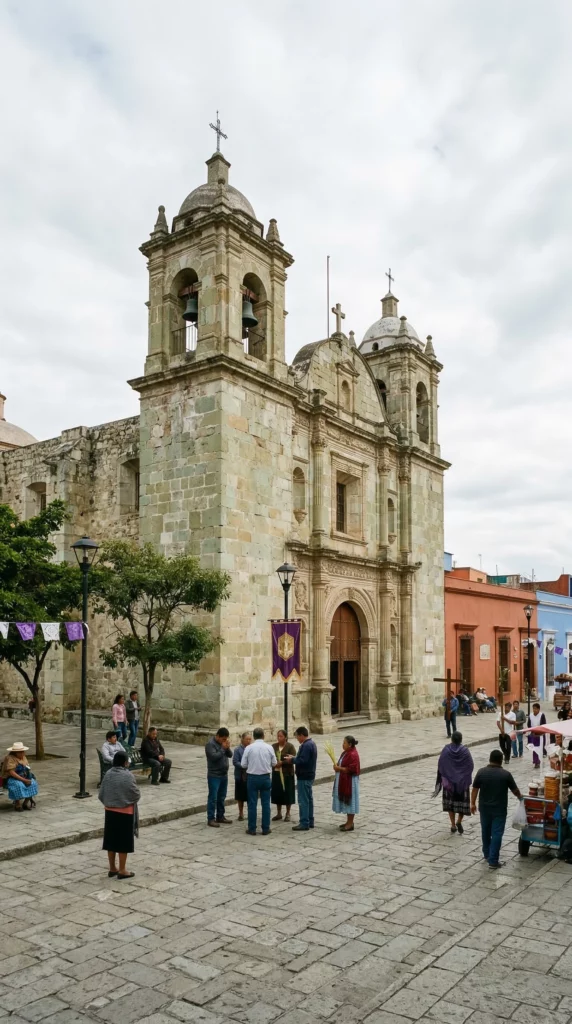
The city’s layout — compact, walkable, and structured around plazas and narrow streets — allows the processions to move naturally through it. Colonial architecture, stone facades, and open squares provide a setting that feels aligned with the pace and tone of the week.
Nothing feels out of place.
The environment supports the ritual without competing with it.
You don’t need to search for where things are happening.
They pass through the city as part of it.
Not a Spectacle
Semana Santa in Oaxaca is not an event designed for visitors.
It is not staged or performed in the way festivals often are. It does not build toward a single moment or peak.
It exists whether you are there or not.
If you happen to be in Oaxaca during this time, what you experience is not something created for you. It is something you observe, briefly, as it continues.
And that changes how you engage with it.
There is no need to seek out the best view or the most significant moment. The experience is found in the quiet consistency of the week — in the movement, the repetition, and the atmosphere that settles over the city.
Semana Santa in Oaxaca is not something you attend.
It’s something you step quietly into.
TLDR
Semana Santa in Oaxaca is a week-long sequence of religious processions and community traditions rather than a single event. Through slow-moving processions, public expressions of faith, and long-standing rituals, the city becomes a space where religion is lived collectively. It is not a spectacle, but a continuation of cultural and spiritual practice.
FAQ
What is Semana Santa?
Semana Santa, or Holy Week, is the week leading up to Easter Sunday in the Christian calendar. It commemorates the final days of Jesus Christ’s life, including his crucifixion and resurrection.
When is Semana Santa in Oaxaca?
Semana Santa takes place in the week before Easter, with exact dates changing each year. It begins on Palm Sunday and concludes on Easter Sunday.
What happens during Semana Santa in Oaxaca?
In Oaxaca, Semana Santa is marked by processions, religious ceremonies, and community participation. Statues are carried through the streets, candles are lit, and the city’s public spaces become part of the observance.
Is Oaxaca a good place to experience Easter?
Oaxaca offers a culturally rich and traditional experience of Easter. Rather than large-scale spectacle, the focus is on ritual, community, and continuity.
Can visitors attend Semana Santa events?
Yes, visitors can observe Semana Santa in Oaxaca, but it is important to do so respectfully. These are religious traditions, not performances, and should be approached with awareness of their cultural and spiritual significance.