Hagia Sophia and the Space I Wasn’t Allowed to Sit In
There are places in the world that feel important before you even understand why.
Hagia Sophia was one of those for me.
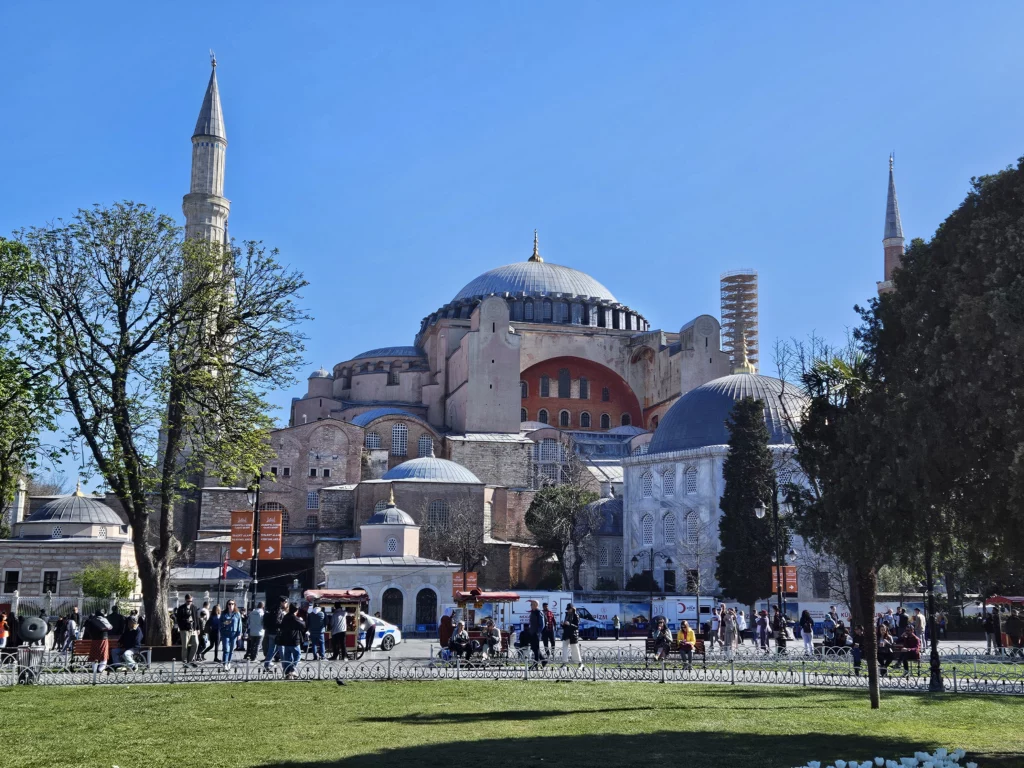
Standing in Sultanahmet Square, watching the afternoon light hit its domes and minarets, I felt a pull I couldn’t quite explain. The building doesn’t shout for attention. It doesn’t sparkle. It doesn’t try to impress you with symmetry or perfection.
It simply stands there — heavy with centuries — as if it knows you will come to it eventually.
And you do.
The First Glimpse
From the outside, Hagia Sophia feels solid and grounded. The pinkish stone, the layered domes, the minarets added centuries after its construction — it looks less like a single idea and more like an accumulation of them.
Church.
Mosque.
Museum.
Mosque again.
It has been all of these things.
And somehow, it still feels whole.
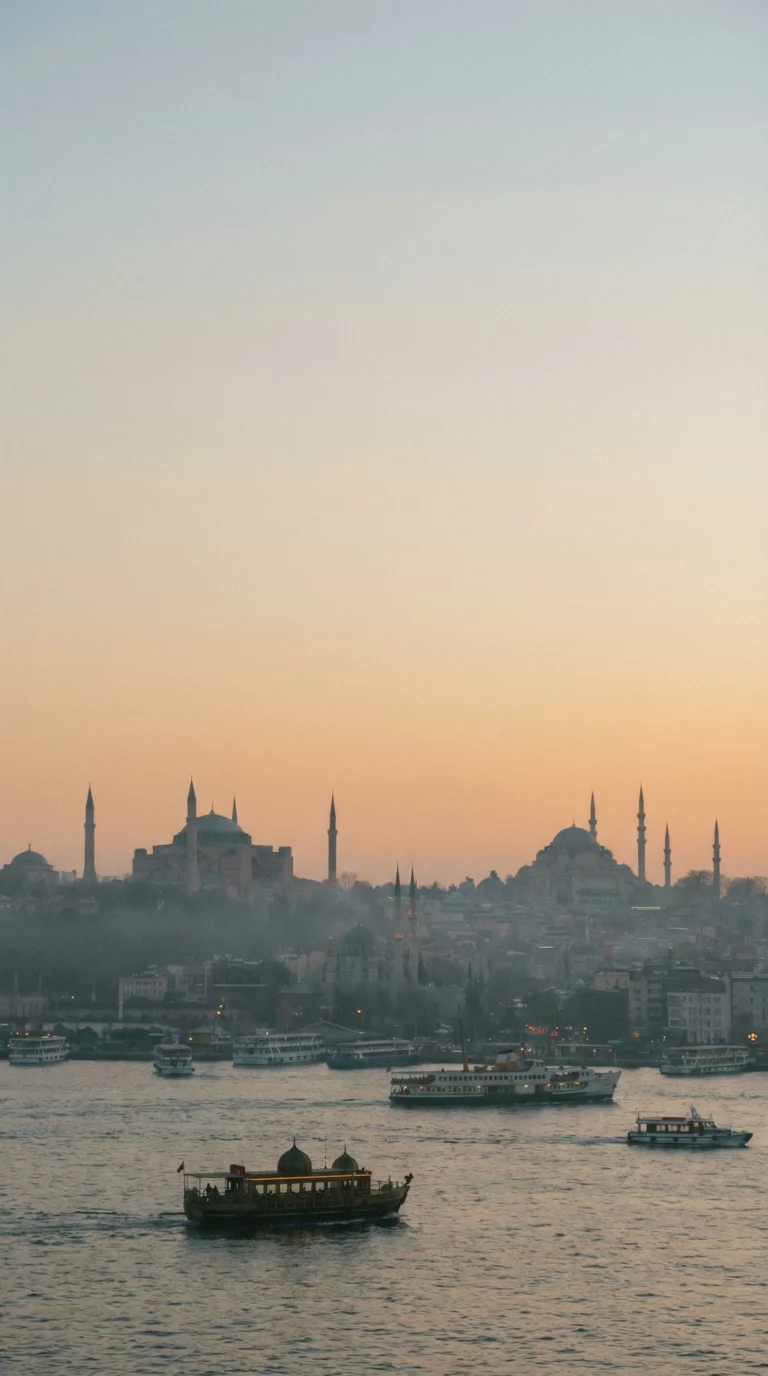
The square around it hums with movement — tour groups, families, the distant echo of the call to prayer rolling across the skyline. Istanbul doesn’t separate the sacred from the everyday. It lets them coexist in the same air.
Walking through the entrance, I wasn’t prepared for what would happen next.
The Space Above
Because the lower level was closed to visitors when I went, we were directed upstairs to the upper gallery.
Climbing the worn stone ramp, I felt anticipation building — and then the space opened.
From above, Hagia Sophia is overwhelming in scale.
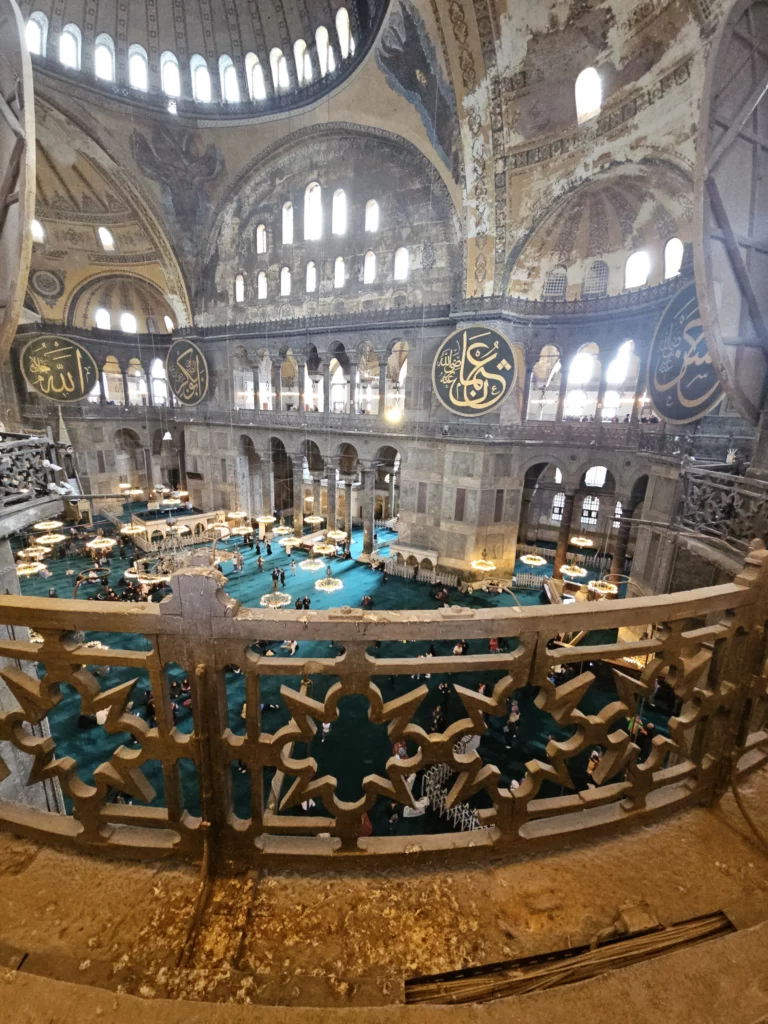
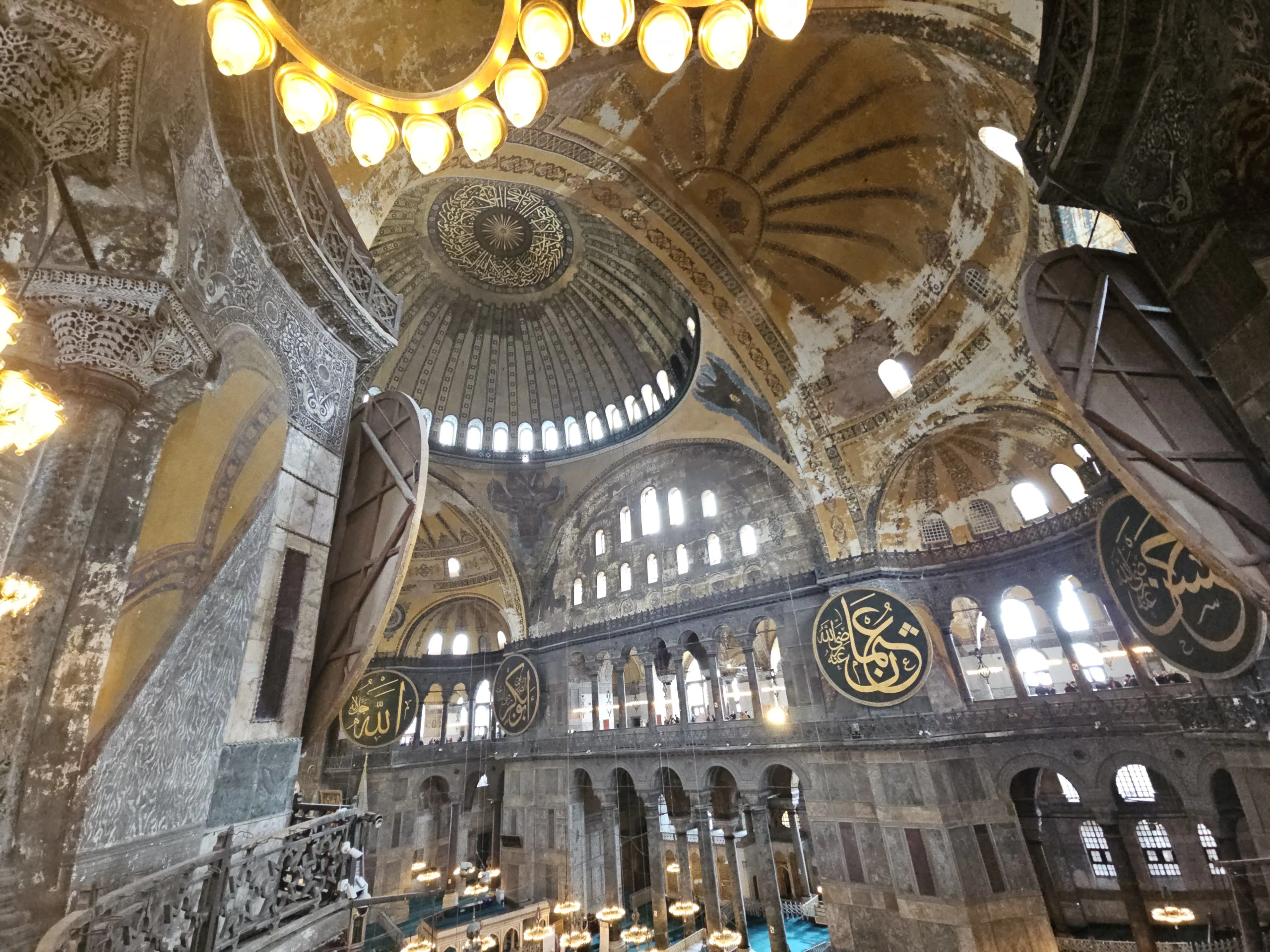
The green carpet below stretches wide and soft. Chandeliers hang low like constellations suspended in air. People move quietly across the floor, their footsteps absorbed into the vastness.
It doesn’t feel loud, even though it’s full of people.
It feels suspended.
From the balcony, you can see everything at once — the arches, the calligraphy discs, the layering of Christian mosaics and Islamic inscriptions, the light filtering in through rows of arched windows high in the dome.
It is impossible not to look up.
And yet, what stayed with me most was not what I saw — but what I couldn’t do.
The Space I Couldn’t Reach
For a reason I still can’t fully explain, I had a strong desire to sit in the middle of the floor.
Not to pray.
Not to perform reverence.
Not even to take a photo.
Just to sit.
To be still in the centre of that vastness and let the scale of it settle.
But the lower level is closed off to visitors now. Ropes and quiet barriers made it clear that this space was not available to me.
I remember feeling unexpectedly disappointed.
It surprised me — that longing. That sense of missing something small but meaningful.
And later, I realised that perhaps the desire itself was the lesson.
Some spaces are not ours to occupy.
Some places are meant to be witnessed, not claimed.
Layers in the Walls
Hagia Sophia is often described as a symbol of conquest or transition — but standing inside it feels less like division and more like accumulation.
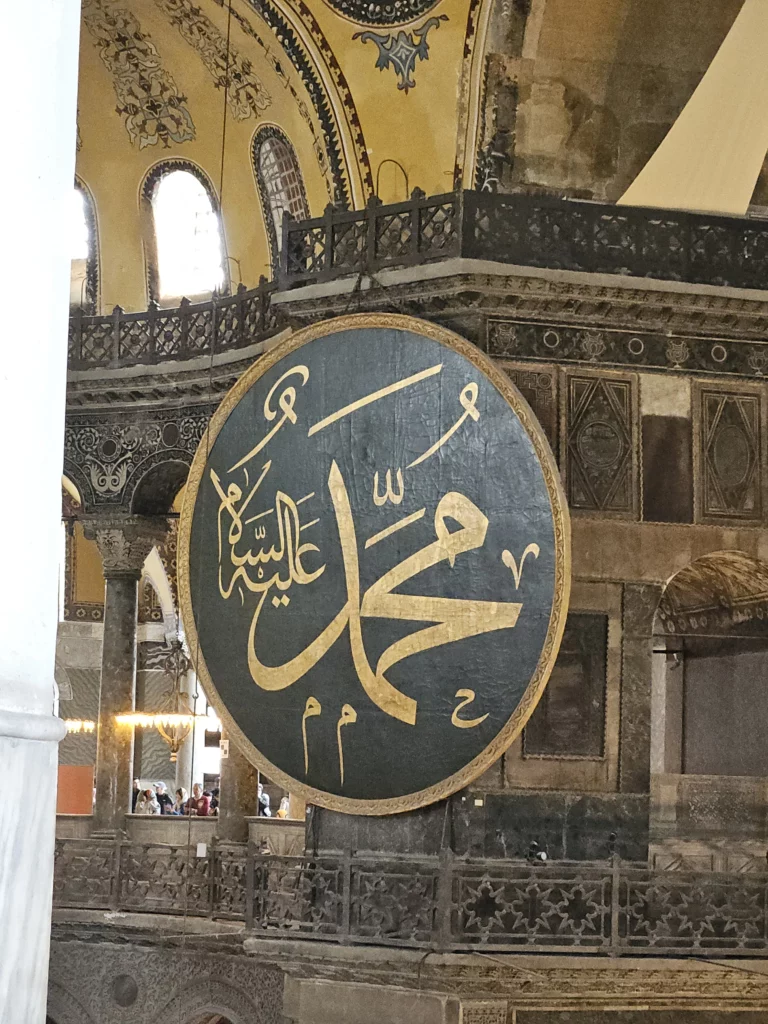
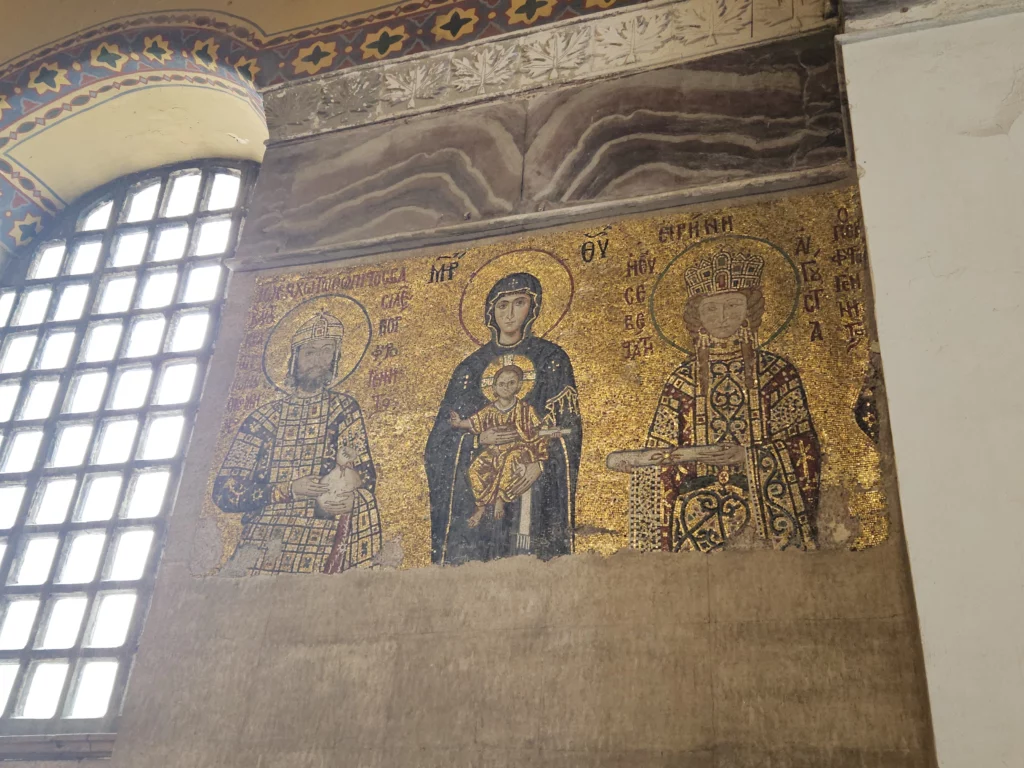
Christian mosaics shimmer in gold against aged plaster. Byzantine emperors gaze outward from centuries-old tiles. High above them, massive black calligraphy medallions bearing Arabic script anchor the space in its current identity.
Neither layer erases the other.
They simply remain.
The building does not try to simplify itself for comfort. It holds contradiction openly.
And in that way, it feels like Istanbul itself.
A city that is not East or West.
Not entirely European, not entirely Asian.
Not one faith, not one story.
Layered. Complex. Alive.
What Hagia Sophia Teaches About Istanbul
Before visiting, I thought of Hagia Sophia as a landmark — something you “see” when you come to Istanbul.
Afterwards, it felt more like a conversation.
It teaches you that identity can evolve without disappearing.
That history doesn’t have to be flattened to be understood.
That something can change purpose and still retain dignity.
And perhaps most unexpectedly — it teaches patience.
You may not always get the experience you imagined.
You may not be able to sit in the middle of the floor.
But sometimes the quiet longing to do so tells you more than the act ever could.
Leaving Without Sitting
When I stepped back into the square, the light felt different.
The noise returned. Vendors called out. Tourists moved in clusters. The city resumed its rhythm.
But I carried something with me — not a checklist ticked, not a photograph framed just right — but a feeling.
A building that refused to simplify itself.
A space that asked to be respected.
And a reminder that sometimes, the layers you cannot access are the ones that linger longest.
TLDR
Hagia Sophia is more than a landmark in Istanbul — it is a living reflection of the city’s layered identity. From its history as church, mosque, and museum to the coexistence of Christian mosaics and Islamic calligraphy, it embodies accumulation rather than erasure. Visiting from the upper gallery, unable to sit on the main floor, became an unexpected lesson in patience and perspective. Sometimes the spaces we cannot fully access are the ones that leave the deepest impression.
FAQ
Is Hagia Sophia currently a mosque or a museum?
Hagia Sophia is currently an active mosque. It was originally built as a cathedral in 537 CE, later converted into a mosque, then a museum in 1935, and reconverted into a mosque in 2020. Visitors can still enter outside of prayer times, though certain areas may be restricted.
Can visitors access the main prayer floor of Hagia Sophia?
Access to the main floor can vary depending on current regulations and prayer times. At times, visitors are directed to the upper gallery level instead. It’s best to check updated visitor guidelines before going.
Do Christian mosaics still exist inside Hagia Sophia?
Yes. Many Byzantine mosaics remain visible inside Hagia Sophia, particularly in the upper gallery. These coexist alongside Islamic calligraphy and architectural elements, reflecting the building’s layered history.
How long should you spend at Hagia Sophia?
Most visitors spend between 45 minutes to 1.5 hours exploring the space. However, if you prefer to move slowly and absorb the atmosphere, you may want longer — especially if access allows you to explore multiple levels.